
 Phoebe Lydia
Tax deduction sets the stage for this enthralling narrative, offering readers a glimpse into a story that is rich in detail and brimming with originality from the outset.
Tax deductions play a crucial role in the taxation system, allowing individuals and businesses to reduce their taxable income, ultimately lowering their tax liability. Understanding the fundamentals of tax deductions is essential for smart financial planning, as they come in various forms and can significantly impact overall financial health. From commonly overlooked deductions to the specific claims available for different professions, tax deductions can create opportunities for savings that many people miss out on. As we delve into this topic, we will explore the various types of tax deductions, the claiming process, and their broader implications for personal finance.
Understanding the fundamentals of tax deductions
Tax deductions play a crucial role in the taxation system, allowing individuals and businesses to reduce their taxable income, thereby lowering the amount of tax owed. By understanding tax deductions, taxpayers can effectively navigate the complexities of tax laws and optimize their financial positions. This concept rests on the principle that certain expenses incurred to generate income should be considered when determining taxable income. Recognizing these deductions not only enhances compliance but also promotes economic activity by encouraging spending in various sectors.
Tax deductions are classified into two main categories: above-the-line deductions and below-the-line deductions. Above-the-line deductions are subtracted from gross income to arrive at adjusted gross income (AGI), which impacts various tax calculations. Examples include contributions to retirement accounts and certain education expenses. Below-the-line deductions, often referred to as itemized deductions, are subtracted after AGI has been calculated; these include expenses like mortgage interest, state and local taxes, and medical expenses that exceed a certain threshold.
Types of tax deductions available
Various tax deductions are available, each serving different purposes and benefiting different taxpayer situations. Understanding these categories can help maximize potential savings, and some commonly overlooked deductions include:
- Medical Expenses: Taxpayers can deduct unreimbursed medical expenses that exceed 7.5% of their AGI. This encompasses a wide range of costs, including prescription medications, surgery, and even transportation to medical appointments.
- State and Local Taxes: Taxpayers can deduct state and local taxes paid, which can significantly reduce taxable income. This includes state income taxes and property taxes.
- Charitable Contributions: Donations to qualifying charitable organizations can be deducted. This includes cash gifts, as well as the fair market value of donated goods.
- Home Office Deduction: Self-employed individuals can claim deductions for business-related expenses in a home office, such as utilities and internet costs, provided they meet specific criteria.
- Student Loan Interest: Individuals can deduct up to $2,500 of interest paid on qualified student loans, provided their income falls within certain limits.
In many instances, taxpayers overlook these deductions, missing opportunities to decrease their overall tax burden. It is crucial to maintain accurate records and receipts for all deductible expenses to substantiate claims during tax filing. Adopting a proactive approach in identifying and leveraging available deductions can lead to significant savings and a more favorable financial outcome.
The process of claiming tax deductions
Claiming tax deductions is a vital aspect of managing your finances, allowing you to reduce your taxable income and, consequently, the amount you owe in taxes. Understanding the process can help you take full advantage of available deductions while ensuring compliance with tax laws. Here’s a detailed guide on how to effectively claim tax deductions on your returns.
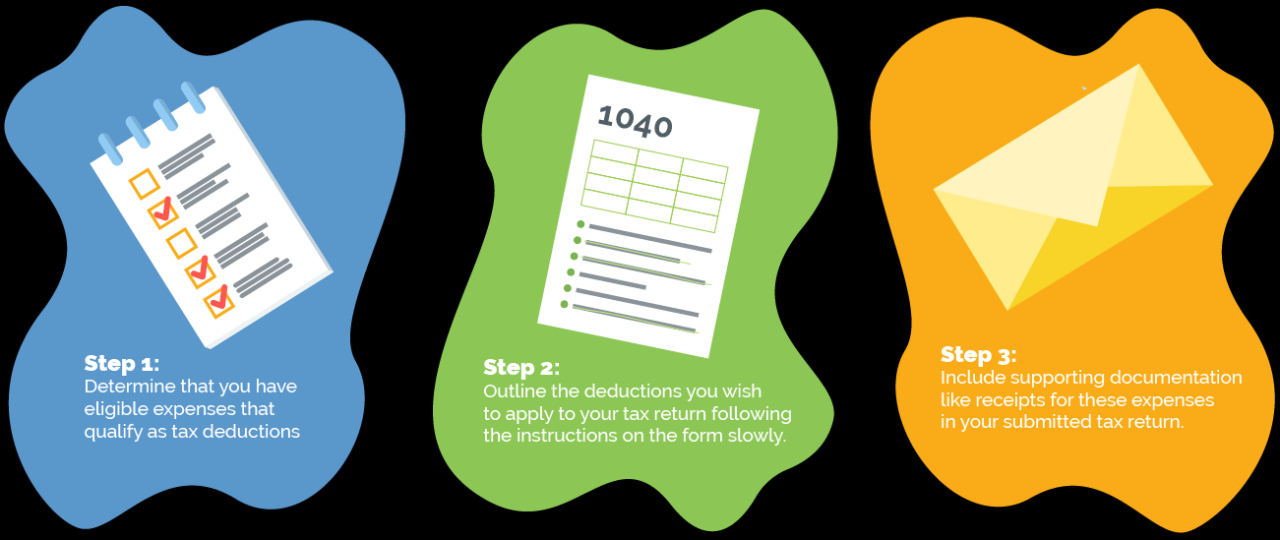
The process of claiming tax deductions involves several key steps that individuals should follow to ensure a successful claim. To start, it is crucial to identify the deductions for which you are eligible. This could include deductions for mortgage interest, medical expenses, charitable contributions, and state taxes paid. After identifying potential deductions, you must gather the necessary supporting documents, complete the appropriate forms, and file your return accurately and on time.
Required steps for claiming deductions
To properly navigate the process of claiming tax deductions, follow these essential steps:
1. Identify Eligible Deductions: Research which deductions apply to your situation. Consider both standard and itemized deductions, depending on which benefits you more.
2. Gather Supporting Documentation: Collect all relevant documents such as receipts, invoices, and bank statements that substantiate your claims.
3. Complete Tax Forms: Use the correct forms provided by the IRS or your local tax authority. If itemizing deductions, ensure you fill out Schedule A (Form 1040).
4. Double-Check Calculations: Verify all calculations to prevent errors that could lead to an audit or penalties.
5. File Your Tax Return: Submit your return by the due date, ensuring that you include all necessary documentation.
Common mistakes when claiming deductions
Avoiding common pitfalls can save you money and stress. Here are frequent mistakes taxpayers make when claiming deductions:
– Neglecting to Keep Records: Failing to maintain thorough documentation can result in lost deductions. Always keep receipts and financial records for at least three years.
– Claiming Non-Eligible Expenses: Some expenses, while potentially significant, may not be deductible. Familiarize yourself with what qualifies as a deductible expense.
– Overlooking Limits on Deductions: Certain deductions come with limits. Be aware of these limitations to avoid claiming excessive amounts.
– Filing Late or Incorrectly: Ensure that your returns are submitted on time and filled out accurately to avoid penalties and interest.
Documentation checklist for supporting claims
Preparing a checklist of necessary documentation is essential for substantiating your tax deduction claims. Here’s a comprehensive list to ensure you have everything covered:
- Receipts: Keep receipts for all deductible expenses, including charity contributions and medical expenses.
- Bank Statements: Utilize bank statements to verify payments made for deductible items.
- Tax Forms: Gather relevant tax forms such as W-2s, 1099s, and any other related documentation.
- Invoices: Collect invoices for business expenses if you are self-employed or claiming unreimbursed employee expenses.
- Proof of Payment: Document methods of payment (checks, credit card statements, etc.) to support your claims.
The impact of tax deductions on personal finance
Tax deductions play a crucial role in shaping personal finance by reducing the overall tax burden on individuals and families. By lowering taxable income, tax deductions can lead to increased disposable income, which can then be allocated towards savings, investments, or expenditures. Understanding how these deductions work can significantly influence financial health and help in effective budgeting.
Tax deductions can have a transformative effect on financial health. They lower the amount of income that is subject to taxation, meaning taxpayers can keep more of their earnings. This increase in net income can facilitate better budgeting, allowing families to allocate funds for essential needs or long-term goals. Moreover, tax deductions can provide a buffer during financial hardships, as they lessen the immediate financial obligations of taxpayers.
Scenarios demonstrating the benefits of tax deductions
Tax deductions can significantly benefit taxpayers in various situations, creating opportunities for improved financial management. Below are specific scenarios where tax deductions can have a noticeable impact:
- Homeownership: Homeowners can deduct mortgage interest and property taxes, reducing their taxable income significantly. This can make homeownership more affordable and encourage investment in real estate.
- Education Expenses: Taxpayers investing in their education or their children’s education may qualify for deductions on tuition and fees, reducing the financial burden of higher education.
- Medical Expenses: Individuals with substantial medical expenses can deduct costs that exceed a specific percentage of their adjusted gross income, easing the financial strain of healthcare.
- Charitable Contributions: Donations to eligible charities can be deducted, which not only helps reduce taxable income but also encourages philanthropy among taxpayers.
Case Study: Financial impact of tax deductions for an average family
To illustrate the financial impact of tax deductions, consider the case of the Smith family, a typical household with an annual income of $75,000. They own a home, have two children, and contribute to their local charity.
In this scenario, the Smiths benefit from several tax deductions:
– Mortgage Interest Deduction: They pay approximately $10,000 a year in mortgage interest, which can be deducted from their taxable income.
– Child Tax Credit: They receive a credit of $3,000 for their two children, directly reducing their tax liability.
– Charitable Contributions: They donate around $2,000 to their local charity, which is also deductible.
By taking advantage of these deductions, the Smith family’s taxable income reduces to $60,000. This tax strategy results in a substantial decrease in their tax obligation, allowing them to retain more of their earnings for savings, emergencies, and family activities. The overall effect enables the Smiths to maintain a healthier financial position while promoting responsible budgeting and investment for the future.
Tax deductions not only reduce taxable income but also empower individuals to manage their finances more effectively and invest in their future.
Tax deductions for different professions
Tax deductions can significantly impact the financial well-being of professionals across various sectors. Understanding the specific deductions available for different professions can optimize tax savings, ultimately benefiting both personal finances and business operations. Each profession brings unique tax scenarios, influenced by job-specific expenses and local regulations.
Different professions have distinct tax deductions that cater to their needs. For instance, teachers often have access to deductions for classroom supplies, while freelancers can deduct business expenses related to their services. Business owners, on the other hand, may have access to a broader range of deductions, including home office expenses and equipment depreciation. It’s also important to recognize that these deductions may vary based on location and the prevailing market conditions. Certain states or regions offer additional incentives that can further enhance these deductions.
Unique deductions by profession
To better understand the unique deductions available to different professions, here are some key examples:
- Teachers: Teachers can deduct unreimbursed expenses for classroom supplies, which may amount to $250 (or $500 if both spouses are eligible). Additionally, they can claim expenses for continuing education and professional development.
- Freelancers: Freelancers can deduct a range of business-related expenses, including office supplies, software subscriptions, travel expenses, and even a portion of their home utilities if they operate from home.
- Business Owners: Business owners benefit from deductions for operating expenses, including rent, salaries, and utilities. They also have the ability to depreciate assets like equipment and vehicles over time.
Understanding these deductions is crucial for maximizing tax efficiency and ensuring compliance with relevant tax regulations.
Comparative deductions across professions
Analyzing the differences in tax deductions across various professions reveals how diverse the landscape is. The following table provides a comparative overview of the types of deductions commonly available:
| Profession | Common Deductions | Key Considerations |
|---|---|---|
| Teachers | Classroom supplies, professional development, educational materials | Geographic variations may affect eligibility and amounts. |
| Freelancers | Home office expenses, business supplies, travel costs | Market conditions influence the scope of deductible expenses. |
| Business Owners | Operating expenses, equipment depreciation, employee salaries | Local tax laws may provide additional benefits or restrictions. |
Each profession has tailored deductions that reflect the nature of the work involved and can vary significantly based on local regulations. This diverse landscape emphasizes the importance of understanding your specific tax situation to leverage available deductions effectively.
The role of tax deductions in charitable giving
Charitable giving plays a significant role not only in supporting various causes but also in providing financial relief for donors through tax deductions. When individuals contribute to qualified charitable organizations, they can often deduct those contributions from their taxable income, resulting in a lower tax bill. This synergy between philanthropy and tax benefits encourages more generous contributions, ultimately benefiting both the donor and the community.
When making charitable contributions, it’s essential to understand the implications for tax deductions. Generally, donations to qualified organizations can be deducted, but there are specific criteria to meet. For instance, contributions made to 501(c)(3) organizations are typically eligible for deductions. This encourages donors to invest in causes they care about while receiving a financial incentive. Moreover, the impact of these deductions can be substantial, reducing the overall tax burden for individuals.
Documentation and requirements for claiming charitable deductions
Accurate documentation is vital for claiming charitable deductions. Donors must maintain records of their contributions to ensure compliance with IRS regulations. The following points highlight the necessary documentation and requirements:
- For cash donations: Keep a bank record or written communication from the charity indicating the amount donated and the date of the contribution.
- For non-cash donations: Obtain a receipt from the charity detailing the items donated, along with their fair market value.
- For contributions exceeding $250: A written acknowledgment from the charity is required, confirming the donation amount and stating whether any goods or services were received in return.
- For donations of vehicles: Complete IRS Form 1098-C, which is provided by the charity, for donations valued over $500.
Ensuring all documentation is in order not only helps in claiming deductions but also serves as a safeguard in case of an audit.
Maximizing charitable contributions for tax benefits
Individuals can strategically maximize their charitable contributions to optimize tax benefits. Understanding various methods of giving can make a significant difference. Consider the following approaches:
- Utilize a donor-advised fund (DAF): This allows individuals to make a charitable contribution, receive an immediate tax deduction, and then distribute funds to charities over time.
- Consider bunching donations: By combining multiple years’ worth of donations into a single tax year, donors can exceed the standard deduction threshold, making itemizing deductions more beneficial.
- Leverage appreciated assets: Donating stocks or real estate that have appreciated in value can provide a double tax benefit by avoiding capital gains taxes and receiving a deduction for the fair market value.
- Explore employer matching programs: Many companies offer matching gifts for employee donations, effectively doubling the contribution and the potential tax deduction.
By implementing these strategies, donors can not only support their favorite causes but also enhance their tax situation, creating a win-win scenario for both philanthropy and personal finance.
Tax deductions and retirement savings
Tax deductions play a crucial role in enhancing retirement savings plans, providing individuals with opportunities to save more for their future. Utilizing tax deductions can significantly reduce taxable income, allowing for greater contributions to retirement accounts such as Individual Retirement Accounts (IRAs) and 401(k) plans. This strategic approach not only fosters a more robust financial future but also takes advantage of current tax laws.
Tax-deductible contributions can maximize the benefits of retirement accounts, making them an essential part of a comprehensive retirement savings strategy. For instance, contributions to a traditional IRA and a 401(k) plan are often made pre-tax, meaning they reduce taxable income in the year they are contributed. This leads to a lower tax bill, while simultaneously boosting the retirement savings pool for future use.
Comparison of retirement accounts and tax deductions
Understanding the advantages and limitations of various retirement accounts is key to optimizing tax deductions. Below are the primary types of retirement accounts, along with their associated tax benefits:
- Traditional IRA: Contributions may be tax-deductible depending on income and workplace retirement plans. Growth is tax-deferred until withdrawal, which occurs at retirement.
- Roth IRA: Contributions are made with after-tax dollars, meaning no immediate tax deduction. However, qualified withdrawals are tax-free, providing tax benefits in retirement.
- 401(k): Employer-sponsored plan where contributions are made pre-tax, reducing taxable income. Employers may offer matching contributions, further enhancing savings.
- Simple IRA: For small businesses and self-employed individuals, allowing both employee and employer contributions with tax-deductible benefits.
The decision between these accounts depends on individual circumstances, including current income levels, tax bracket, and retirement goals. For example, high earners might benefit more from the immediate tax deductions offered by a traditional IRA or a 401(k), while younger individuals in lower tax brackets may prefer the long-term benefits of a Roth IRA.
Strategies for maximizing retirement savings through deductions
Implementing effective strategies can help individuals make the most of tax deductions to enhance their retirement savings. Here are some recommended approaches:
- Maximize Contributions: Aim to contribute the maximum allowable amount to retirement accounts each year to leverage tax deductions fully. For 2023, the contribution limit for 401(k) plans is $22,500, with an additional catch-up contribution of $7,500 for those aged 50 and older.
- Consider Employer Matching: Always contribute enough to take full advantage of any employer match in a 401(k) plan, as this is essentially free money added to retirement savings.
- Utilize Tax-Loss Harvesting: Offset capital gains taxes by selling underperforming investments, allowing for reinvestment in retirement accounts while maintaining eligibility for tax deductions.
- Evaluate Tax Bracket Changes: If anticipating a higher tax bracket in the future, consider prioritizing contributions to traditional IRAs and 401(k)s now, taking advantage of current lower rates.
Implementing these strategies can significantly impact long-term retirement savings, allowing individuals to grow their nest egg while enjoying immediate tax benefits. By being proactive and informed about tax deductions, individuals can better prepare for a financially secure retirement.
The future of tax deductions in changing tax laws
As tax laws continue to evolve, the landscape of tax deductions is also shifting. Recent updates to tax legislation are making it crucial for taxpayers to stay informed about how these changes will affect their potential deductions. Understanding these alterations is not just about compliance; it can significantly impact financial planning and tax liability.
Recent changes, such as the revisions to itemized deductions and adjustments made through various stimulus packages, have redefined what taxpayers can claim. For instance, the increase in the standard deduction in recent years has simplified tax filing but also reduced the incentive for some to itemize. With these developments, individuals and businesses must adapt their strategies to maximize their deductions.
Recent Changes in Tax Laws and Their Impact
The recent trend of tax reforms has reshaped various aspects of deductions available to taxpayers. Notable changes include:
- Increased Standard Deduction: The standard deduction has nearly doubled in recent years, affecting many taxpayers who previously itemized. For example, for the 2022 tax year, the standard deduction for single filers rose to $12,950, allowing many to claim this amount without needing to document individual expenses.
- Changes to Itemized Deductions: Certain itemized deductions, such as those for state and local taxes (SALT), have been capped at $10,000, which has impacted high-income earners significantly, reducing their ability to deduct large amounts previously allowable.
- Impact of COVID-19 Legislation: Temporary tax benefits, like the above-the-line deduction for charitable contributions introduced during the pandemic, have provided additional avenues for deductions that may not continue in the future.
Tax experts are closely monitoring these trends and predict that taxpayers should brace for more adjustments as lawmakers continue to address fiscal challenges. For instance, the ongoing discussions about wealth taxes and the potential for new deductions related to green energy investments are gaining traction.
Emerging Trends Influencing Tax Deductions
Several emerging trends could further influence tax deductions in the coming years. Understanding these trends is essential for effective tax planning:
- Shift Toward Digital Services: As more businesses migrate to online platforms, potential deductions related to e-commerce expenses and digital tools may arise. This shift allows businesses to leverage deductions for software, cybersecurity, and online marketing.
- Green Initiatives: The growing emphasis on sustainability is prompting discussions around tax incentives for environmentally-friendly practices. Tax credits for electric vehicle purchases and energy-efficient home improvements are becoming more common.
- Remote Work Deductions: The rise of remote work due to the pandemic may lead to changes in how home office expenses are deducted, with possible new provisions allowing individuals to claim a portion of their home-related expenses.
Tax professionals suggest staying ahead of these trends by maintaining organized records, consulting with tax advisors regularly, and adjusting financial plans accordingly to take full advantage of available deductions.
“Being proactive in understanding tax law changes can lead to significant savings and strategic financial advantages.”
Final Conclusion

In summary, tax deductions are a powerful tool for managing your finances more effectively. By understanding the different types of deductions available and the process for claiming them, taxpayers can make informed decisions that enhance their financial well-being. Whether through charitable contributions, retirement savings, or profession-specific allowances, tax deductions offer opportunities that can lead to substantial savings. As tax laws evolve, staying informed about potential changes and trends will ensure that you maximize your benefits now and in the future.
Commonly Asked Questions
What are tax deductions?
Tax deductions reduce your taxable income, lowering the amount you owe in taxes.
Who can claim tax deductions?
Both individuals and businesses can claim tax deductions if they meet specific criteria.
Are all tax deductions the same?
No, tax deductions vary by type, eligibility, and the specific tax laws that apply.
How do I know which deductions I qualify for?
Consulting a tax professional or researching the IRS guidelines can help identify eligible deductions.
Can I claim tax deductions for previous years?
Yes, you may be able to amend past tax returns to claim deductions you missed during previous filings.
What happens if I make a mistake on my tax deduction claim?
Correct any mistakes as soon as possible by amending your tax return, which may reduce penalties or interest.
Do tax deductions affect my eligibility for credits?
Yes, certain deductions can impact your income level, which may affect your eligibility for tax credits.